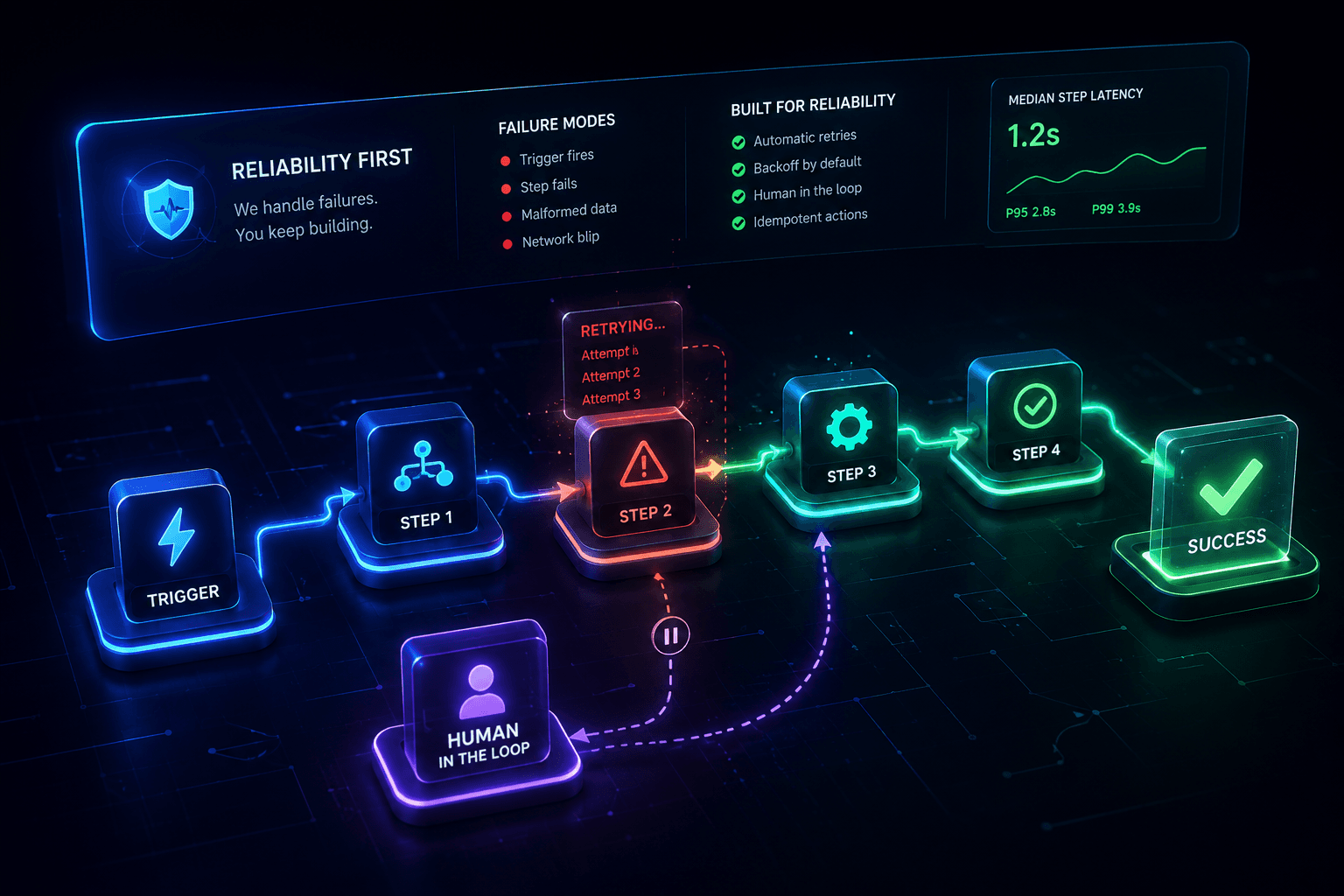
Most automation platforms optimize for the demo: a trigger fires, three steps run, a green checkmark appears. Production looks nothing like that. APIs time out, a model returns malformed JSON, a webhook fires twice. The question that actually matters is what happens next.
Retries are not a feature, they are the baseline
Every step in Aigent retries with backoff by default, and every retry is visible in the run log, not hidden behind a spinner. If a step fails three times, the workflow pauses and routes to a human instead of silently dropping the run. We built this in before we built a UI for it, because a workflow that fails silently is worse than one that never ran.
The harder problem is idempotency. If a payment webhook fires twice because a network blip caused a retry, running the charge step twice is a real financial bug, not an edge case. Every action step in Aigent takes an idempotency key derived from the run, so a duplicate delivery is a no-op instead of a double charge.
Speed is what you get after reliability
Once a system does not lose data, you can start making it fast. Median step latency on Aigent is 1.2 seconds, but that number only means something because 99.98% of runs also complete correctly. We would rather ship a slower step that always finishes than a fast one that sometimes does not.
